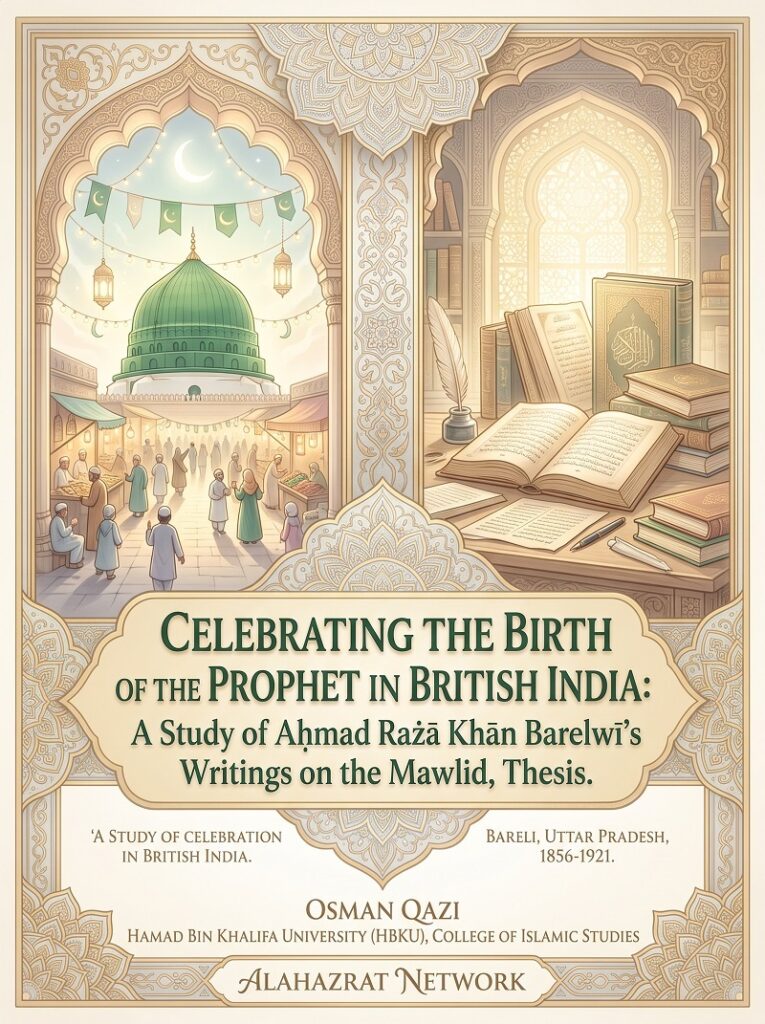
Celebrating the Birth of the Prophet in British India: A Study of Aḥmad Rażā Khān Barelwī’s Writings on the Mawlid is a Master’s thesis (dissertation) authored by Osman Qazi at Hamad Bin Khalifa University (HBKU) within the College of Islamic Studies. The study explores the legal, theological, and socio-historical dimensions of Mawlid (the celebration of the Prophet Muhammad’s birth) in colonial South Asia, centering on the prolific rulings of Imam Aḥmad Rażā Khān (1856–1921)—the chief jurist of the Barelwī (Ahl-e Sunnat) movement. Qazi examines how the ritual transformed into a major identity marker and a central point of debate among competing Sunni factions, particularly between Barelwī, Deobandī, and Ahl-i Ḥadīth scholars. It demonstrates how Aḥmad Rażā defended Mawlid not as a prohibited innovation (bid‘ah sayyi’ah), but as a commendable one (bid‘ah ḥasanah) grounded in classical Islamic jurisprudence, justifying core devotional acts such as poetry recitation (na‘at), feeding the needy, and standing in veneration (qiyām).
At the same time, the research details the strict jurisprudential boundaries and regulations that Aḥmad Rażā placed upon these gatherings to distinguish orthodox devotional practice from uncritical folk custom. The thesis highlights his explicit condemnation of widespread corruptions, such as the recitation of fabricated (mawḍū‘) historical narratives, heterodox or pantheistic poetry bordering on the deification of the Prophet, and frivolous or commercially driven performances. Ultimately, Qazi illustrates that Aḥmad Rażā’s advocacy for the Mawlid was a nuanced, systematic project aimed at legitimizing traditional devotional Sufi practices while anchoring them firmly within the bounds of orthodox Hanafi law and Sunni prophetology.